Compare San Francisco whale watching tour types by season, boat size & duration. Honest advice on gray whales, humpbacks, Farallon Islands trips & booking tips.
Who Should Book a Whale Watching Tour
A San Francisco whale watching tour works best for travelers who already like being outdoors and don't mind a few hours of open-water chop in exchange for seeing something wild. If you've done boat trips in Monterey or kayaked in Puget Sound near Seattle, you'll know the drill: long stretches of scanning the horizon punctuated by a few minutes of genuine adrenaline when a fin or tail breaks the surface. That trade-off isn't for everyone.
Photographers and serious wildlife watchers get the most value here, especially those who've already tried land-based whale spotting at Point Reyes or Monterey's shoreline and want the closer, open-ocean encounter that only a boat trip to the Farallon Islands or the outer Gulf of the Farallones can provide. Couples looking for something more memorable than a Golden Gate photo op also do well — a few hours offshore with humpbacks surfacing nearby beats another walk across the bridge for making a trip feel distinctive.
I'd steer solo travelers on a tight schedule toward the shorter bay-adjacent trips rather than full-day Farallon excursions, simply because a bad weather day can eat 7-8 hours you don't have. World travelers comparing San Francisco against Baja California gray whale trips or Alaska humpback cruises should know San Francisco's season is shorter and the seas choppier — this isn't a sheltered-bay experience like whale watching near Ensenada's lagoons.
Family-Friendly and Accessibility Considerations
Most operators set a minimum age, often around 8-10 years old, for full-day Farallon Islands trips — not because of boredom risk, but because the crossing beyond the Golden Gate gets genuinely rough, with swells that regularly hit 4-6 feet even on calm days. Families with younger kids are better served by shorter bay tours lasting 2-3 hours, which stay in more protected waters and still offer decent odds of sightings during peak humpback season.
Wheelchair access varies significantly by vessel — smaller boats often require stepping down into a cabin with narrow stairs, while larger vessels out of Fisherman's Wharf tend to have more stable, flatter boarding. If mobility is a concern, call ahead and ask about boarding specifics rather than assuming; this isn't something tour listing pages reliably disclose.
Experience Level and Seasickness Concerns
Be honest with yourself about seasickness before booking a full-day trip. The water past the Golden Gate Bridge toward the Farallones is open ocean, not bay water, and it moves differently — rolling swells rather than choppy waves. Take motion sickness medication the night before and morning of, not after symptoms start; by the time you feel queasy on a moving boat, it's often too late for oral medication to help much. Staying on deck in fresh air and fixing your eyes on the horizon helps more than hiding below in the cabin, which is usually where things feel worse.
Whale Species & Seasonal Calendar
San Francisco's whale watching calendar splits roughly into two windows, and knowing which one you're booking into changes what you'll likely see. This is the detail most visitors skip, then wonder why their December trip didn't deliver the humpback breaches from the brochure photos.
Gray Whales and Migration Patterns
Gray whale season in San Francisco runs roughly December through April, tracking their migration between Alaska's feeding grounds and Baja California's breeding lagoons. Southbound migration (December-January) tends to move faster and farther offshore; the northbound return (March-April), often with calves, brings whales closer to shore and is generally considered the better viewing window. Grays are slower-moving and surface more predictably than humpbacks, which makes them a bit easier to photograph — though they breach far less dramatically.
Humpback and Blue Whales
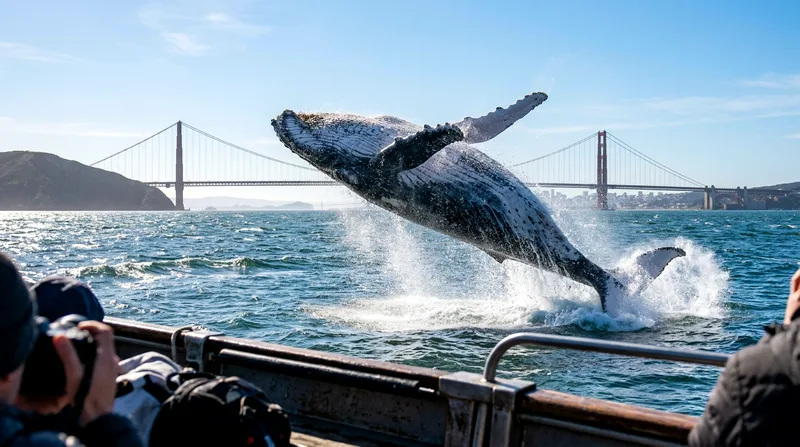
Humpback whale tours in SF peak from roughly July through October, when humpbacks (and occasionally blue whales) feed in the nutrient-rich waters around the Farallon Islands, drawn by seasonal upwelling that concentrates krill and anchovies. This is the window serious photographers target, since humpbacks breach, tail-slap, and lunge-feed near the surface — far more visually dramatic than gray whale sightings. Blue whale sightings are a bonus, not a guarantee; they're less predictable and tend to appear later in the season, into early October.
Tour Types: Boat Size, Duration & Sighting Guarantees
Tours out of San Francisco fall into a few clear categories, and the right one depends on how much time and tolerance for rough water you've got. Organizations like Oceanic Society run small-group, naturalist-led trips focused on research and conservation, while larger commercial operators such as SF Whale Watching Tours run bigger vessels with higher passenger counts and more frequent departures.
Full-day small-boat trips to the Farallon Islands during summer and fall give the best odds of humpback sightings, while shorter bay tours in winter and spring suit gray whale season and families.
San Francisco whale watching tour types compared by boat size, duration and best season
| Tour Type | Duration | Boat Size | Best Season | Typical Sighting Odds |
|---|---|---|---|---|
| Bay/Golden Gate half-day | 2-4 hours | Medium-large | Dec-Apr (gray whales) | Moderate |
| Farallon Islands full-day (small boat) | 7-8 hours | Small, 20-30 pax | Jul-Oct (humpbacks) | High |
| Farallon Islands full-day (large vessel) | 7-8 hours | Large, 60-100+ pax | Jul-Oct (humpbacks) | High, steadier ride |
| Naturalist/conservation trip (e.g. Oceanic Society style) | Full-day | Small, 15-25 pax | Jun-Nov | High, educational focus |
| Combo bay cruise with wildlife stops | 2-3 hours | Medium | Year-round | Low-moderate, bonus sightings |
Figures as of 2024; seasonal timing and sighting odds vary year to year with ocean conditions and whale migration shifts.
Small Boats vs. Large Vessel Tours
Small boats, typically carrying 20-30 passengers, get you closer to the action and usually come with a dedicated naturalist narrating sightings — useful if you actually want to learn something rather than just snap photos. The trade-off is a rougher ride; smaller hulls pitch more in swell, and there's less shelter if weather turns. Larger vessels, carrying 60-100+ passengers, ride steadier in chop and often have indoor cabins, restrooms, and snack bars, but you'll be sharing rail space with far more people when something surfaces, and the boat can't maneuver as nimbly toward a sighting. If photography is your priority, small boats generally win; if comfort and seasickness risk are bigger concerns, go larger.
Half-Day and Full-Day Options
Half-day trips (roughly 3-4 hours) typically stay within the bay or just outside the Golden Gate, suited to gray whale season when whales pass relatively close to shore. Full-day trips (7-8 hours) push out to the Farallon Islands, 27 miles offshore, and are essentially the only way to reliably see humpbacks and the marine life — breeding seabird colonies, elephant seals, sometimes great white sharks — that make the Farallones a biodiversity hotspot worth the longer crossing. The full-day option costs more and demands more physically, but it's the version worth comparing against a Monterey Bay trip, which offers similarly productive waters with a notably calmer bay to start from.
What to Look for When Booking
Booking a whale watching tour in San Francisco isn't like booking a Napa Valley wine tour where the product is fairly standardized — boat quality, crew experience, and weather windows vary a lot, and the difference between a forgettable trip and a great one often comes down to details buried in the fine print.
Inclusions, Group Size and Cancellation Policies
Check whether the price includes hot drinks, snacks, or a box lunch on full-day trips — some do, many don't, and an 8-hour trip without food included means packing your own. Ask about group size caps; a boat advertised for "up to 49 passengers" at full capacity feels very different from the same boat at half that. Cancellation policy matters more here than almost any other San Francisco activity, because operators frequently cancel or reschedule Farallon Islands trips due to swell and wind — look for a policy offering a free rebooking or full refund for weather cancellations, not just a credit.
Sighting Guarantees and Marine Life Coverage
Some operators offer a "sighting guarantee" — a free or discounted return trip if you see no whales. Read what counts: a few operators count dolphins, sea lions, or seabirds as satisfying the guarantee, which feels like a bait-and-switch if you came specifically for whales. Reputable trips, including those run in partnership with groups like Golden Gate Audubon, tend to be upfront that sightings aren't guaranteed and that the value is in the whole marine ecosystem — porpoises, sea lions, blue sharks, and tens of thousands of nesting seabirds around the Farallones — not just the whales themselves.
Best Time to Book Your Tour
Book humpback season trips (July-October) at least 2-3 weeks ahead if you want a weekend departure; these sell out faster than gray whale season trips because the sightings are more dramatic and word travels on photography forums and social media. Weekday departures in September, often the peak month for both humpback numbers and calmer late-summer seas, tend to have better availability and thinner crowds on deck.
For gray whale season, booking a week or two out is usually fine — demand is steadier but lower overall, and operators run trips more predictably since the route stays closer to shore. If you're combining San Francisco with a broader California or West Coast trip — say, pairing it with Monterey Bay's year-round marine life tours or a Lake Tahoe ski weekend on the other side of the state — build in a flexible day or two around your whale watching date. Weather cancellations are common enough that a rigid one-day window risks losing the trip entirely. Always compare current prices and reviews for specific departure dates before you book, since availability and conditions shift week to week.
Frequently asked questions
What is the best month for whale watching in San Francisco?
September is generally the strongest single month — it sits at the peak of humpback whale season (roughly July-October) with typically calmer late-summer seas than earlier in summer. If you specifically want gray whales, aim for March or April, when the northbound migration brings whales, often with calves, closer to shore than the faster southbound push in December-January.
How much does a San Francisco whale watching tour cost?
Prices vary by boat size, trip length, and operator, so check live pricing before booking rather than relying on a fixed figure. As a general pattern, half-day bay tours cost less than full-day Farallon Islands trips, and smaller naturalist-led boats often price higher than large commercial vessels due to lower passenger counts and more personalized narration.
What marine life can you see besides whales?
The Farallon Islands support one of the largest seabird breeding colonies in the continental US, plus resident Steller sea lions, harbor seals, elephant seals, and regular sightings of Risso's and Pacific white-sided dolphins. Blue sharks and even great white sharks are occasionally spotted near the islands in late summer and fall, though sightings of sharks from the boat itself are rare.
Are whale watching tours suitable for families with young children?
Short bay tours (2-4 hours) work reasonably well for kids around 6 and up who can handle some rocking and standing at the rail. Full-day Farallon Islands trips are a harder call — many operators set a minimum age around 8-10 due to open-ocean swell, and 7-8 hours on a boat tests most young children's patience regardless of the age minimum.
What is included in a typical whale watching tour package?
Most tours include use of binoculars, a naturalist or crew member narrating sightings, and restroom access on larger boats. Food and drink inclusion varies widely — some full-day trips include a light lunch or snacks, others don't — so check the listing specifics and pack your own snacks and water as a backup, especially on 7-8 hour trips.