Compare San Francisco bus tour vs walking tour options: cost, coverage, pace, and accessibility for families, seniors, and solo travelers.
Bus Tours vs Walking Tours at a Glance
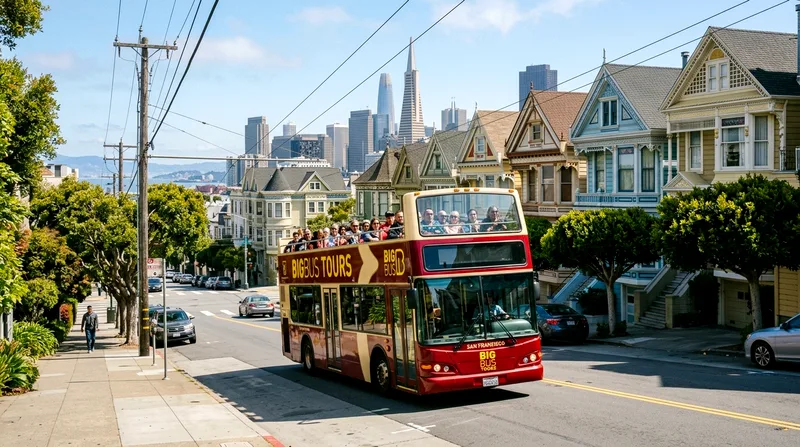
The San Francisco bus tour vs walking tour decision usually comes down to one question: do you want to cover ground, or do you want to feel the ground under your feet? Both get you past the Golden Gate Bridge, Fisherman's Wharf, and Chinatown, but they deliver completely different days. A hop-on hop-off bus from an operator like Big Bus Tours stitches together neighborhoods that are a genuine slog on foot — the Marina, Pacific Heights, the Presidio — while a walking tour slows down in exactly the places buses can't really access, like the alleys of Chinatown or the stairway streets of Telegraph Hill.
I'd pick the bus if you have one day and want the postcard shots without the leg burn. I'd pick walking if you have two days and actually want to remember details beyond "we saw the bridge from a bus window." Plenty of visitors do both, and that's not a cop-out answer — it's genuinely the most efficient use of 48 hours in this city.
What hop-on hop-off buses offer
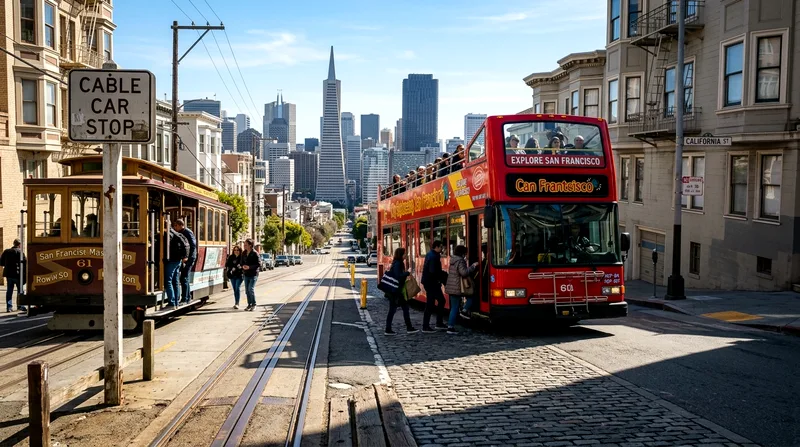
A double-decker bus ticket typically buys you one or two days of unlimited re-boarding across multiple loops — usually a downtown/Fisherman's Wharf route and a separate Golden Gate Park/ocean route. You get recorded or live narration, an open-top deck for photos, and the ability to skip a stop entirely if you're not interested in, say, the Haight. The honest downside: traffic. Lombard Street and Fisherman's Wharf back up badly on weekend afternoons, and a loop that should take 90 minutes can stretch past two hours. Book morning departures if you can.
What walking tours deliver
Walking tours run smaller — usually 10 to 25 people — and last 2 to 3 hours covering one neighborhood deeply: Chinatown and North Beach together, or the Mission's murals, or a Haight-Ashbury counterculture route. You get a human guide instead of a recording, which means actual Q&A, and you get into spaces no bus can reach, like Chinatown's produce alleys or Jack Kerouac Alley. The trade-off is obvious: you're not seeing the Golden Gate Bridge or the Presidio unless the tour specifically routes there, and most don't.
Coverage, Pace, and Time Commitment
Coverage is where the bus clearly wins on paper. A typical hop-on hop-off loop covers 15 to 20 stops across roughly 20 miles, touching downtown, Fisherman's Wharf, Golden Gate Park, and often a Golden Gate Bridge photo stop near the toll plaza. Walking a comparable distance would take most people the better part of a day, hills included. But coverage isn't the same as experience — you're seeing the bridge from a moving vehicle, not standing on it, which matters if photography or the actual crossing is the point.
Geographic reach and neighborhoods covered
Bus routes favor the flatter, wider arterials — Van Ness, Lombard, the Great Highway — because double-decker buses can't navigate the narrow grid of Chinatown or North Beach's steep one-way streets. That's precisely the terrain walking tours specialize in. If your priority list includes both the Golden Gate Bridge and Chinatown's back alleys, no single tour type gets you both; you need the bus for the bridge approach and a walking guide (or your own legs) for Chinatown.
Flexibility and crowd management
Hop-on hop-off tickets, sold through platforms like GetYourGuide and Klook as well as direct operator sites, let you exit at a stop, spend three hours at Fisherman's Wharf, and catch a later bus — usually arriving every 15 to 30 minutes depending on season. Walking tours run on a fixed schedule with no re-boarding; once you commit to the 10am Chinatown tour, you're locked into that group's pace for the full 2 to 3 hours. For crowd avoidance, early morning wins on both fronts, but walking tours handle tight alleys better since the guide can route around a sudden tour-bus crowd that just got dropped off.
Cost Comparison and Value
Neither option is expensive relative to a day of individual Uber rides or parking downtown, which routinely runs $40 to $60 for a few hours in a garage. The real cost question is value per hour, not sticker price.
Bus tours cover more ground for a higher price, while walking tours cost less but demand more stamina and cover far less distance.
San Francisco bus tour vs walking tour: cost, coverage, and comfort compared
| Option | Typical cost (per adult) | Duration | Distance covered | Best for | Physical demand |
|---|---|---|---|---|---|
| Hop-on hop-off bus (1-day) | $50-75 | Full day, re-boardable | Approx. 20 miles, multiple loops | First-timers, seniors, families | Low |
| Hop-on hop-off bus (2-day) | $70-100 | Two days | Same routes, repeatable | Longer stays, photographers | Low |
| Guided walking tour (Chinatown/North Beach) | $25-50 | 2-3 hours | Single neighborhood, 1-2 miles | Solo travelers, couples, foodies | Moderate to high (hills) |
| Guided walking tour (Golden Gate Park or Mission) | $25-45 | 2-3 hours | Single district, mostly flat | Families, casual walkers | Low to moderate |
| Muni day pass (self-guided) | Approx. $5 | Flexible | City-wide, no narration | Budget travelers, repeat visitors | Variable |
Typical published price ranges; always check current prices and routes when booking, since operators adjust fares seasonally.
Typical pricing for each option
Hop-on hop-off bus passes generally run in the $50 to $75 range for a one-day adult ticket and $70 to $100 for a two-day pass, with child tickets discounted roughly 30 to 40 percent. Walking tours are usually cheaper per booking — commonly $25 to $50 per person for a 2 to 3 hour guided neighborhood tour — though some food-focused Chinatown or North Beach tours price higher because they include tastings. Free "tip-based" walking tours exist too, but tip expectations usually land around $15 to $20 per person, so they're not really free.
Hidden costs and add-ons
Watch out for bus tour upsells — many operators bundle a bay cruise or Alcatraz add-on into a "combo" ticket priced well above the base fare, and Alcatraz tickets sell out separately through the National Park Service concession anyway, so check that you're not double-paying. On the walking side, the hidden cost is usually food: Chinatown and North Beach tours that include tastings often charge $70-plus, which is reasonable if you're hungry but inflates the comparison if you're just counting "tour cost." Public transit (Muni) is the budget alternative to both — a single ride is $2.50-ish and a day pass covers buses, streetcars, and cable cars — but you lose narration entirely.
Accessibility and Physical Demands
This is the section that should actually drive your decision if mobility, stamina, or weather tolerance are concerns — more than price, honestly.
Mobility considerations and comfort
Most double-decker buses have a lower-deck seating area and ramp or lift access for wheelchairs, though availability varies by operator and vehicle, so confirm wheelchair-accessible departures when booking rather than assuming every bus in the fleet is equipped. The upper open-air deck requires stairs and isn't a realistic option for anyone with significant mobility limits. Walking tours, by contrast, have zero seating and no mechanical assist — if a guide says "moderate walking," expect sustained inclines, especially on any route touching Russian Hill, Telegraph Hill, or Nob Hill. For seniors or anyone with knee or hip issues, ask the walking tour operator about grade and total distance before booking; a flat Golden Gate Park tour is a completely different physical experience than a Chinatown-to-Coit-Tower route.
Weather and terrain challenges
San Francisco's fog and wind are real factors, not just atmosphere. The open-top deck of a hop-on hop-off bus gets cold fast near the bridge and the ocean side of the route, even in July — bring a layer regardless of what the forecast says downtown. Walking tours expose you to the same fog but also to the city's famous hills, where grades exceeding 15 percent aren't unusual on streets like Filbert or Hyde. Rain is the great equalizer: a bus keeps you dry between stops, while a walking tour in a downpour is genuinely unpleasant and some operators cancel or reroute with little notice.
Who Should Choose Each Option
There's no universal right answer here, but there are clear patterns by traveler type.
Best for families and groups
Families with kids under 10 generally do better on the bus — young children tire of walking long before adults do, and the novelty of the open top deck buys you at least 45 minutes of good behavior. Big Bus Tours and similar operators typically price children's tickets at a discount, and the hop-on hop-off structure means you can bail on a stop if a meltdown is brewing. Larger groups of friends or extended family also benefit from the bus's flexibility, since everyone can split off at Fisherman's Wharf and reconvene later rather than being locked into one guide's pace.
Best for seniors and solo travelers
Seniors with any hill-climbing concerns should lean bus, specifically confirming wheelchair or low-mobility accommodations ahead of time. Solo travelers are the one group I'd push toward walking tours more often than not — small-group walks are genuinely social in a way a bus deck with headphones isn't, and solo travelers tend to appreciate the guide interaction and the built-in conversation starters with other travelers. If you're solo and short on energy, though, don't force it; the bus is a perfectly fine solo activity too, and nobody's judging you for sitting down for three hours.
The Verdict: Which Tour Wins?
If you're forcing a single winner: the hop-on hop-off bus wins for efficiency, accessibility, and first-time orientation to a sprawling, hilly city. It's the better choice if you're also comparing San Francisco against a drivable day trip to Napa Valley or Monterey, since it mirrors that same "cover distance, see the highlights" logic without needing a rental car. The walking tour wins for depth, cost-per-hour, and the kind of specific memory — a Chinatown tea shop, a North Beach bakery — that a bus window can't deliver.
Compare that to Los Angeles, where distances are so vast that walking tours barely exist outside a few districts, or Seattle and Portland, both far more walkable city cores where locals genuinely question why you'd bus it. San Francisco sits in between: compact enough to walk a neighborhood properly, hilly enough that a bus earns its fare for cross-town coverage. My actual recommendation, if your schedule allows two days: bus on day one for orientation and the big landmarks, walking tour on day two for Chinatown, North Beach, or the Mission. It costs maybe $100 to $150 total per person and gives you both the postcard shots and the stories worth telling later.
Frequently asked questions
Is the hop-on hop-off bus worth it in San Francisco?
Yes, if it's your first visit or you have limited mobility — it covers 15-20 stops across the city's hilliest terrain for $50-75 a day, which beats arranging taxis to the same spots. It's less worth it if you're staying more than three days, since you'll see the same loop repeat and start craving neighborhood-level detail.
What is the best way to see San Francisco in a day?
Combine a morning hop-on hop-off loop for the Golden Gate Bridge, Fisherman's Wharf, and Golden Gate Park with an afternoon walking tour of Chinatown or North Beach. Start the bus by 9am to beat traffic backups near Lombard Street, and book the walking tour for 1pm or later so you're not rushing between the two.
How walkable is San Francisco for tourists?
Very walkable in flat districts like the Marina, Mission, and Embarcadero, but genuinely tough on hills around Nob Hill, Russian Hill, and Telegraph Hill, where grades can exceed 15 percent. Chinatown and North Beach are compact and walkable despite some slope. Pace yourself and expect to use Muni or a cable car to skip the steepest stretches.
Are bus tours suitable for seniors and people with disabilities?
Generally yes — most operators offer lower-deck seating and some vehicles have wheelchair ramps or lifts, but availability varies by fleet, so confirm accessible departures when booking rather than assuming. The open-top upper deck requires stairs and isn't suitable for limited mobility.
Can you combine bus tours with walking tours?
Yes, and it's the most efficient approach for a two-day visit. Book the bus pass through a platform like GetYourGuide or Klook for day one's orientation, then book a 2-3 hour neighborhood walking tour for day two — there's no booking conflict since they're separate tickets from different operators.